
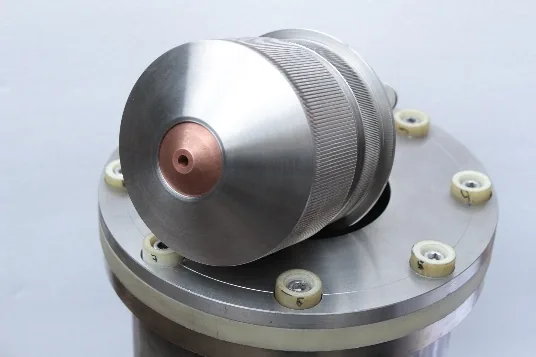
Description
Purpose and operating principle
The equipment applies wear-resistant, corrosion-resistant, thermal barrier and special functional coatings. Spraying is performed both with standardised solid, composite and metal-cored wires with various fillers, and with powders of metals, alloys, carbides, borides, oxides and cermet materials.
The unit operates on direct current, reverse polarity. What sets it apart from other conventional APS (Atmospheric Plasma Spraying) systems — made by Oerlikon Metco, FST, Praxair Surface Technologies and others — is the remote water-cooled tungsten electrode with adjustable position, and the torch discharge chamber with copper tubular electrodes, where one electrode (the plasma-forming nozzle) is electrically insulated from the arc power supply.
These design solutions extend nozzle service life by 40–60 % compared with conventional two-electrode non-transferred arc torches with a plasma-forming anode nozzle (F1, F4MB, 9MB, SG-100 and others). Both traditional Ar- and He-based gas mixtures and mixtures based on N and CO2 can be used — impossible for conventional designs with tungsten thermionic cathodes. Heat transfer from the plasma arc to the powder or wire particles introduced into it is highly efficient.
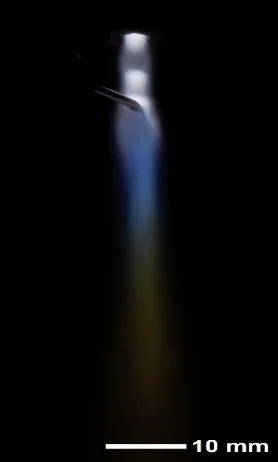
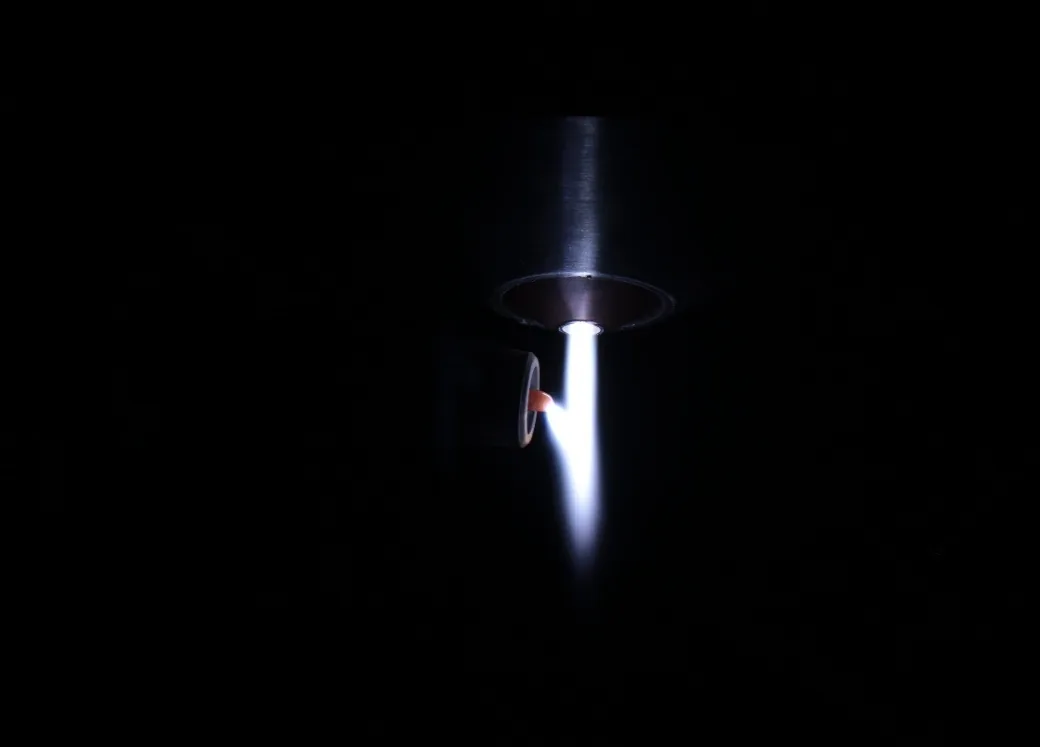
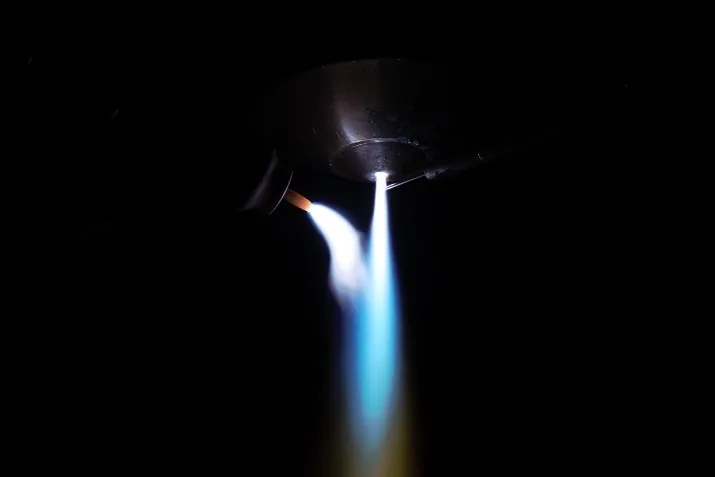
Key process parameters
| Parameter | Value |
|---|---|
| Mass-average plasma temperature, K | 7000–12000 |
| Plasma jet velocity, m/s | 600–3000 |
| Sprayed particle velocity, m/s | 200–700 |
| Maximum spraying rate, kg/h | 8–12 |
| Electrical power, kW | 50–150 |
| Material utilisation ratio | 0.60–0.95 |
Distinctive features
- argon, helium, nitrogen and their mixtures — with each other and with hydrogen or methane additions (in some cases water vapour) — can be used as the plasma gas. This ensures efficient melting and acceleration of dispersed particles: Cu, Ni, W, Mo, WC–Co, Cr3C2–NiCr, ZrO2–YSZ, Al2O3 and others;
- adjusting the position of the remote electrode changes the arc length — the arc section beyond the nozzle exit spans 25–150 mm. Combined with control of the plasma gas composition, this allows torch power to be varied over a wide 50–150 kW range, creating the conditions to melt and accelerate virtually any dispersed material;
- control of the plasma gas composition and flow rate produces a high-velocity, high-enthalpy plasma jet with an outflow velocity of M = 0.5–2.0 and a specific enthalpy of h₀ = 9–32 kJ/kg. Both dense coatings with porosity below 1 vol. % and coatings with controlled porosity of 1–15 vol. % can be produced;
- the torch can operate in air, in a controlled (protective) atmosphere and in dynamic vacuum;
- the torch design supports both subsonic and supersonic modes at Mach numbers M = 1.5–2.0 and above;
- the unit can be supplied with either of two torch types — with a standard tubular anode electrode, or with a dedicated electromagnetic system that extends tubular anode service life by 30–40 %;
- higher material utilisation: 0.60–0.70 for ceramic and 0.60–0.80 for cermet powders. For comparison, conventional APS with powder injection at the nozzle exit gives 0.45–0.65 and 0.50–0.75 respectively. The gain comes from the greater length, cross-section and enthalpy of the plasma jet, which improves powder heating;
- a wide range of standard powders as well as solid, composite and metal-cored wires can be used; with wire materials the utilisation ratio reaches 0.90–0.95.
Main and auxiliary units
| Unit | Qty, pcs |
|---|---|
| Plasma torch with a standard tubular anode electrode, with a remote water-cooled electrode of adjustable position | 1 |
| Dedicated power supply, operating current up to 300 A and voltage up to 600 V, for a torch of 50–150 kW | 1 |
| Control system integrated with the gas preparation unit, with a programmable PLC | 1 |
| Mobile control console with a touch panel | 1 |
| Twin-hopper powder feeder, 5 l per hopper | 1 |
| Wire feed mechanism with a spool holder and brake | 1 |
| Set of cables, accessories and spare parts | 1 |
Optional equipment (subject to agreement with the customer):
- plasma torch with a dedicated electromagnetic system (extended anode service life) and a remote water-cooled electrode of adjustable position;
- spray booth with a CNC manipulator, or a robotic cell in an isolated enclosure;
- workpiece manipulator — single-axis or dual-axis positioner;
- water cooling system for the torch and the adjustable electrode;
- gas cylinder rack for the plasma gases.
Main technical specifications
| Parameter | Value |
|---|---|
| Open-circuit voltage, V | 600 |
| Arc operating voltage, V | 150–500 |
| Arc operating current, A | 100–300 |
| Main plasma gas flow rate (argon, helium, nitrogen, mixtures), Nm³/h | 3.5–12 (60–200 l/min) |
| Combustible gas addition (methane, propane), Nm³/h | 0.3–1.5 (5–25 l/min) |
| Cooling water flow rate, m³/h | 2.0–2.5 (30–40 l/min) |
| Powder particle size, µm: ceramics, cermets metals, alloys |
15–25 or 15–45 15–45 or 38–75 |
| Maximum spraying rate, kg/h: ceramic powders metal powders solid and metal-cored wires | 3–6 6–12 4–8 |
| Utilisation ratio with powder | 0.60–0.70 |
| Utilisation ratio with wire | 0.80–0.95 |