
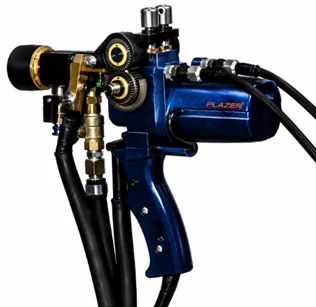
Description
Purpose and operating principle
Supersonic activated arc spraying unit: ergonomic twin-wire head • integrated catalytic combustion chamber • working gas: compressed air with an addition of propane (methane)
PL-S-TWAS-15 is a supersonic system for activated twin-wire arc spraying, designed to produce dense coatings (porosity <2 vol.%) with high adhesion (>40 MPa) and high performance characteristics. Coatings are applied using solid wires (carbon and stainless steels, alloys based on nickel, copper, titanium, aluminium, molybdenum and others), as well as metal-cored wires consisting of a metal sheath with a cermet and/or carbide-containing filler. Compressed air with additions of a combustible gas (methane, propane, synthesis gas, etc.) is used as the working gas.
The unit implements the arc spraying process using a high-velocity gas jet that is formed in the compact combustion chamber of the spraying head as a result of catalytically stabilised combustion of a mixture of compressed air with a combustible gas. This ensures effective atomisation, acceleration and transport of the molten particles of the sprayed material, contributing to the formation of coatings with increased density, high productivity and reduced oxidation.
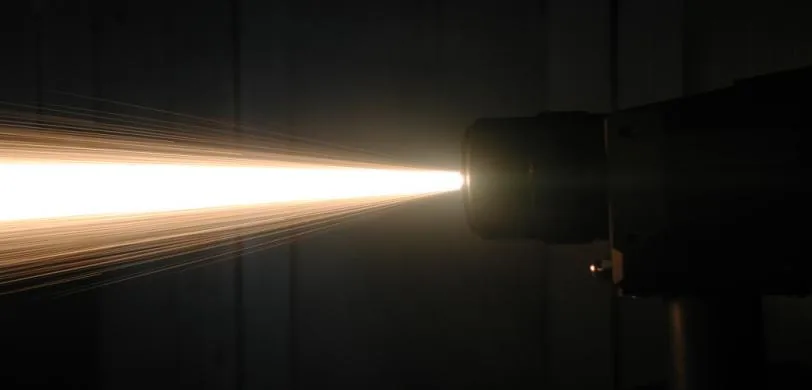
Main process indicators
| Main process indicators | Value |
|---|---|
| Particle temperature, K | >2000 |
| Jet velocity, m/s | >1000 |
| Velocity of the sprayed material particles, m/s | >350 |
| Maximum spraying capacity, kg/hour | 8-18 |
| Material (wire) utilisation factor | 0.7-0.9 |
Design of the spraying head
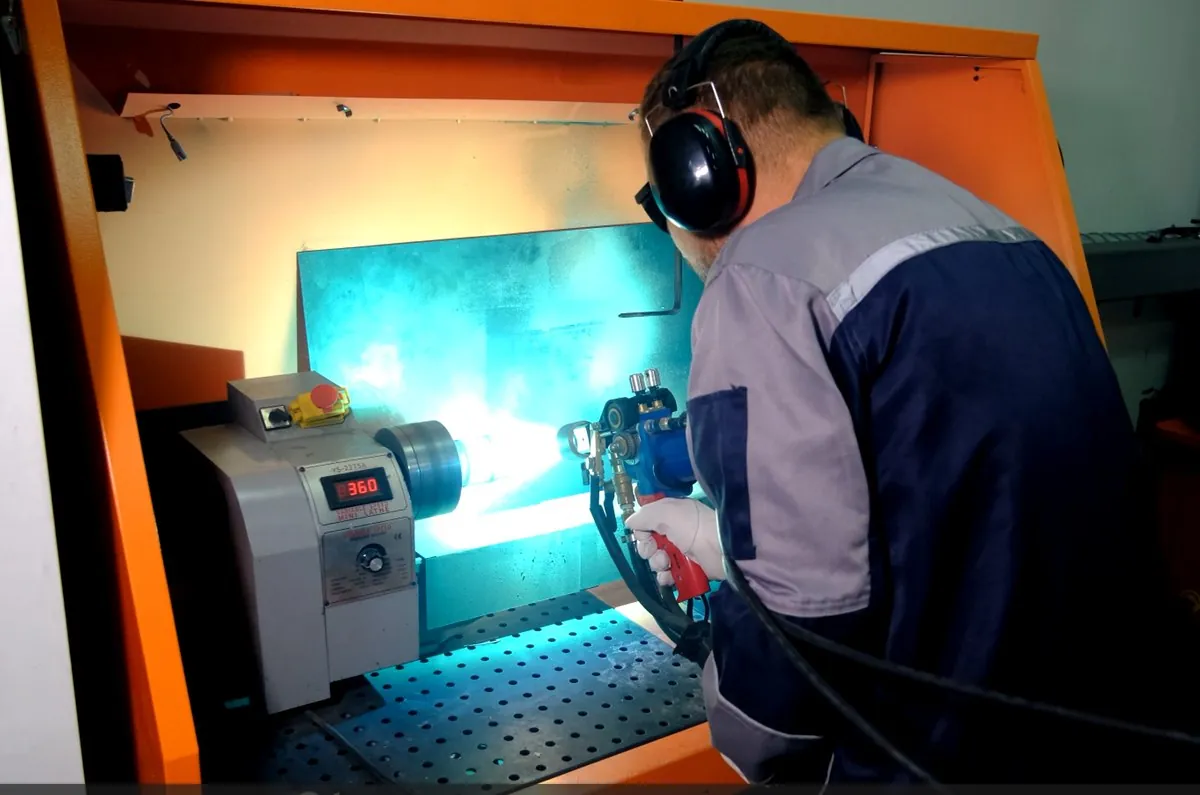
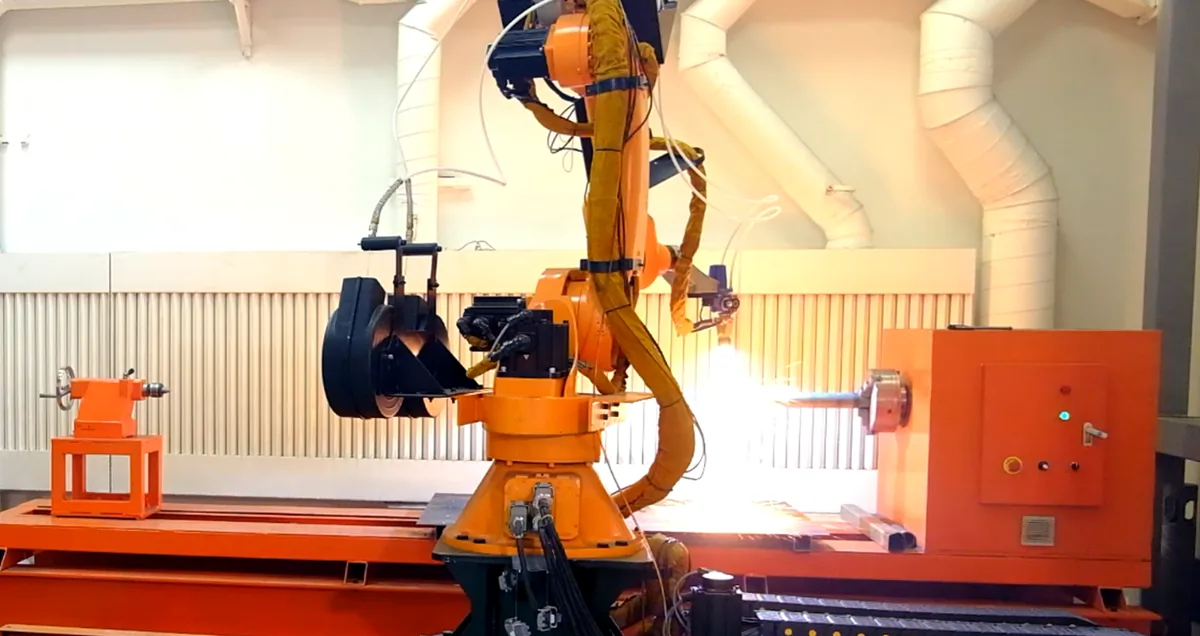
The design of the spray gun head incorporates an integrated compact combustion chamber with an original high-temperature ceramic catalyst, which provides intensive activation of the combustion products, acceleration of the high-temperature gas flow to supersonic velocities and effective atomisation of the molten particles. This ergonomic design makes it possible to combine the high spraying velocities typical of stationary high-velocity systems with the compact dimensions and low weight of the supersonic spraying head (gun). Thanks to this, the unit can be used both in manual mode and as part of mechanised, coordinate or robotic complexes, providing high coating quality on parts of practically any shape and size.
Specification of the PL-S-TWAS-15
| Units of the installation | Quantity, pcs. |
|---|---|
| Main: | |
| Head for supersonic arc spraying with a wire feed mechanism | 1 |
| Integrated process monoblock: power supply • control • gas preparation • wire feed | 1 |
| Wire spool holder | 1 |
| Set of hoses with connecting couplings | 1 |
| Set of spare parts and tools | 1 |
| Operating manual | 1 |
| Auxiliary options (as agreed with the customer): | |
| 1. Spraying chamber with a CNC manipulator, or a robotic complex in an insulated booth) | — |
| 2. Workpiece manipulator (single-axis or two-axis rotator) | — |
| 3. Air compressor | — |
| 4. Cylinder rack for combustible gas | — |
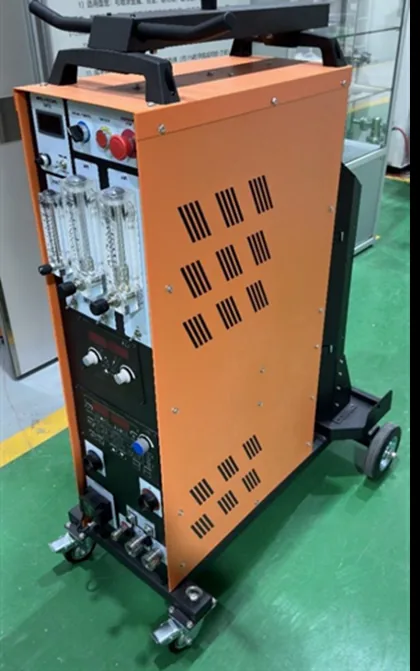
Main technical characteristics of the PLAZER S TWAS 15
| Parameter | Value |
|---|---|
| Three-phase AC mains voltage at 50 Hz, V | 380 (−10…+5 %) |
| Arc operating current, A | 50-400 |
| Arc operating voltage, V | 25-45 |
| Electric power consumption, kW, not more than | 20 |
| Air pressure, MPa | 0.5–0.8 |
| Air consumption, l/min | ≥2000 |
| Combustible gas pressure, MPa | 0.5-0.6 |
| Combustible gas consumption, l/min | 10-50 |
| Wire diameter, mm | 1.4–2 |
| Head cooling type | air |
| Overall dimensions of the monoblock (L×W×H) providing power supply, gas preparation, control and process monitoring, mm, not more than | 840 × 505 × 1150 |
| Overall dimensions of the supersonic arc spraying head with the wire feed mechanism (L×W×H), mm, not more than | 350 × 110 × 280 |