
Adaptive Welding and Hardfacing Control Based on Laser Triangulation
The adaptive control technology for welding and additive hardfacing, based on laser triangulation, provides automatic seam tracking, geometry control of welds, deposited beads and the formed part, and real-time correction of the tool path.
The technology uses laser-triangulation machine vision and automatically compensates for geometric deviations during arc, plasma and laser welding, hybrid processes based on them, and additive hardfacing. The solution integrates with industrial robots and automated systems, forming a closed feedback loop between the process and the vision system.
How it works
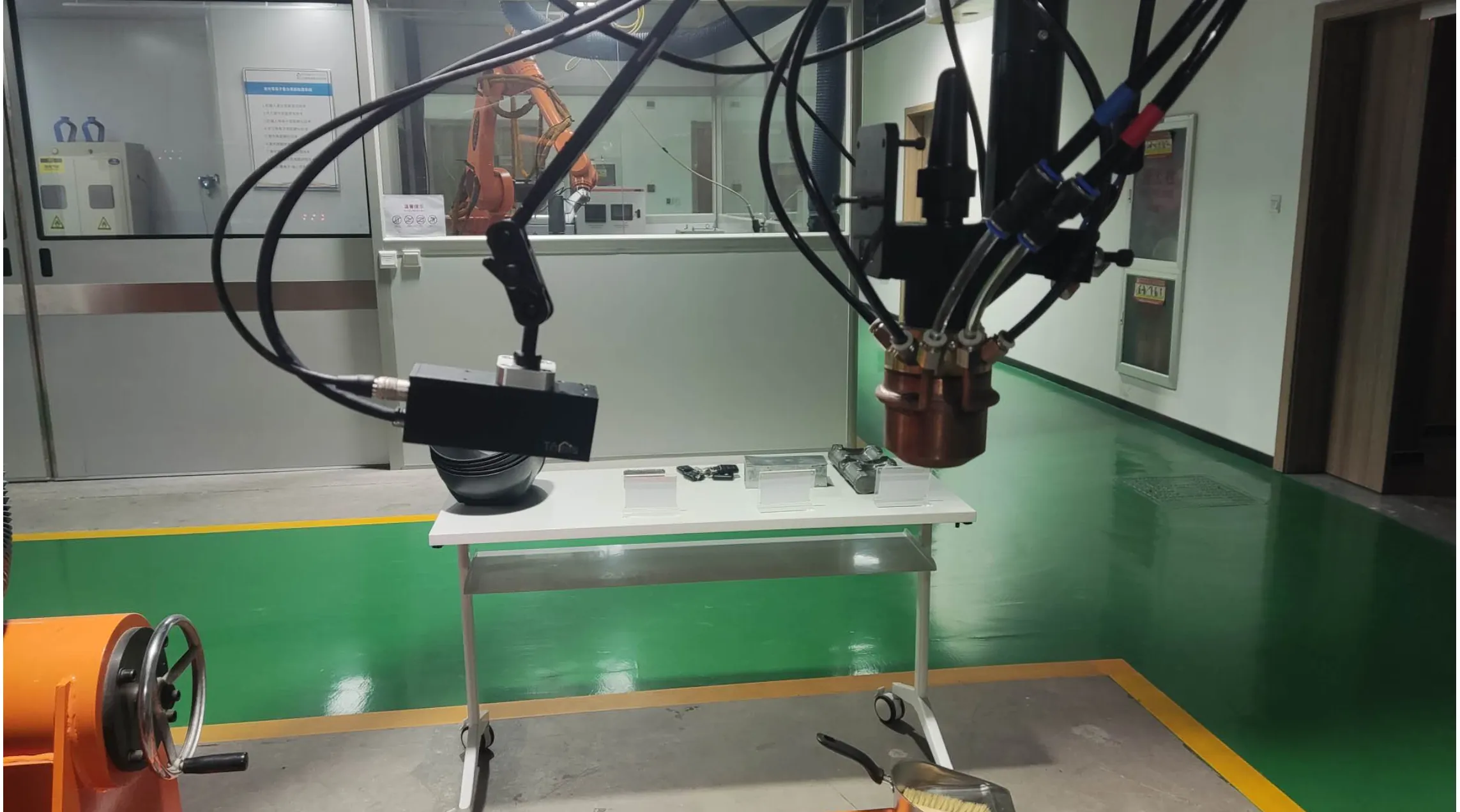
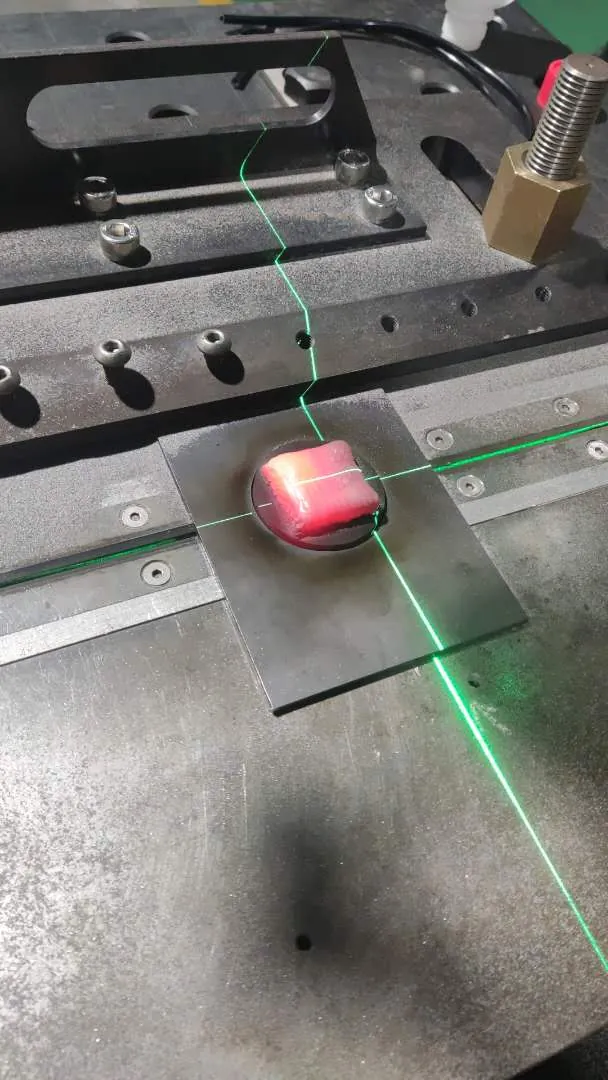
The technology is based on non-contact determination of the spatial geometry of a weld seam or deposited layer by laser triangulation. A laser line is projected across the controlled zone on the part surface, and a camera registers it at a set angle. Changes in the surface profile — gap, edge offset, height difference or a change in the geometry of the deposited layer — shift the laser line in the frame accordingly. This data is used in real time to determine the geometric parameters and coordinates of the controlled zone, which are then used to automatically correct the tool path.
Controlled geometric parameters
Laser-triangulation control provides real-time determination of the geometric parameters of the weld seam, deposited layer and the surface of the formed part:
- coordinates of the weld seam and its deviation from the set path;
- edge offset and gap changes;
- surface height and deposited layer height;
- width of the seam, weld or deposited bead;
- profile and relief of welds and deposited beads;
- deviation of the part's actual geometry from the nominal one.
This data is used not only for control, but also directly for adaptive correction of the process.
Key capabilities
Precision real-time geometric control
- automatic seam tracking during motion;
- determination of the spatial position and deviations of the controlled zone along X, Y, Z;
- recognition of seams with minimal or zero gap;
- measurement of seam, weld or bead width, surface height and deposited layer height;
- control of the profile of beads, layers, walls, grooves and complex spatial contours;
- geometry control of the part directly during additive build-up;
- positioning accuracy — down to 0.1 mm.
Adaptive path control
- automatic correction of the tool position based on the actual seam or surface geometry;
- maintaining the set stand-off height of the torch, plasmatron or nozzle relative to the part;
- adaptation to changing gaps, edge offsets and height differences;
- compensation of accumulated Z-axis error during layer-by-layer build-up;
- correction of the path and process parameters based on the geometric control results.
Stable control under welding and hardfacing conditions
- robust geometry detection under intense welding or plasma arc radiation;
- stable control under intense light and aerosol exposure.
Technological advantages
- non-contact geometry detection without stopping the process;
- measurement data is processed directly on the built-in computing module, without streaming video to an external PC;
- measurement, analysis and control combined in a single process cycle;
- control of both the seam geometry ahead of the weld pool and the formed weld, bead or deposited layer;
- control parameters adapt to the part geometry and the specific process task.
Production impact
- higher accuracy and repeatability of the geometry of welded structures and additively formed parts;
- stable formation of welds, beads and layers along complex spatial paths;
- fewer defects and less production scrap;
- less dependence of the result on operator skill;
- lower accuracy requirements for workpiece assembly and tooling;
- less need for manual correction of the robotic process;
- higher automation level and stability of serial production.
Integration
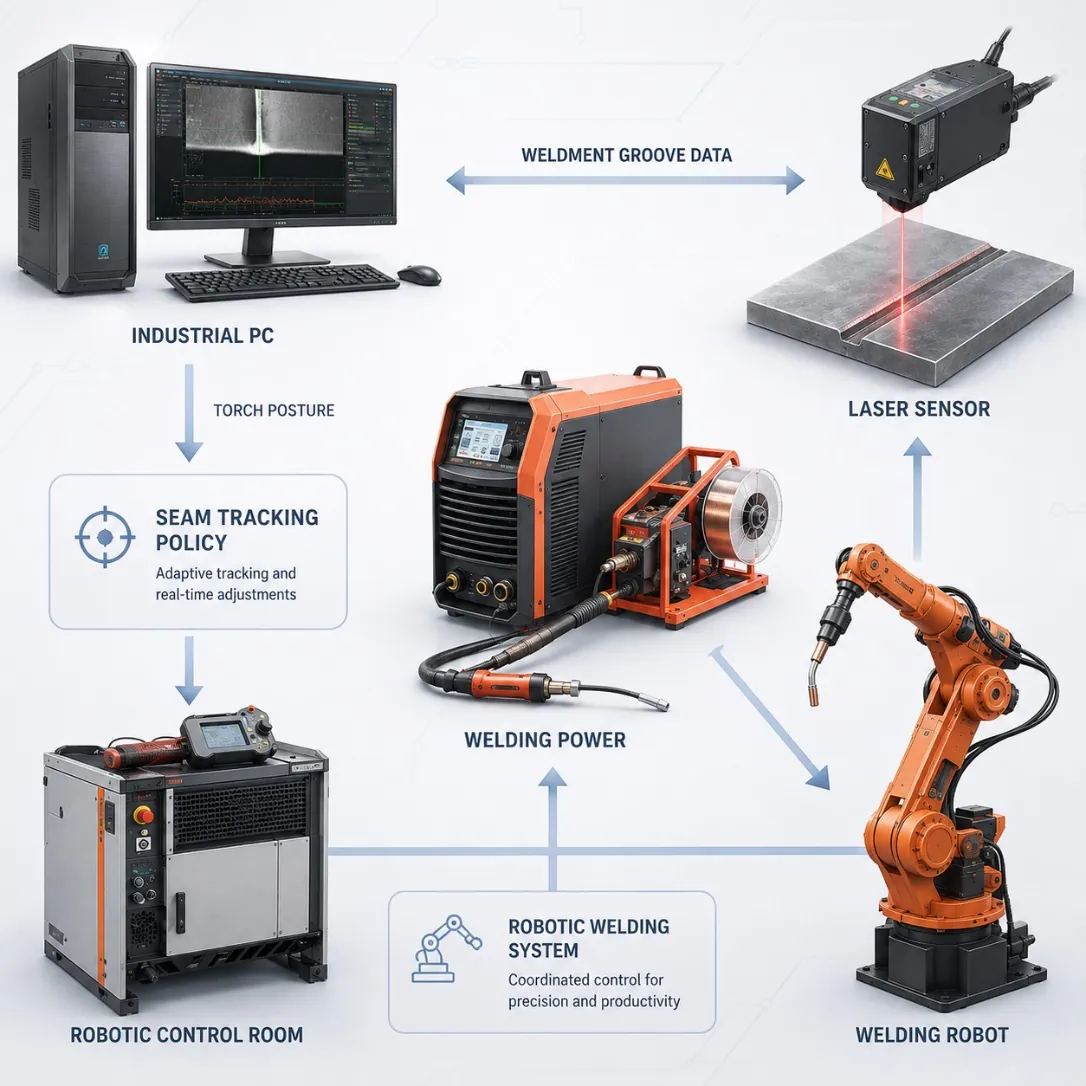
The technology integrates with industrial robots, manipulators, CNC machines and welding process control systems, and can be built into new robotic systems as well as retrofitted into existing production lines.
Applications
The technology can be applied to robotic MIG/MAG and TIG welding, plasma and laser welding, hybrid processes, plasma and arc additive hardfacing, WAAM printing, and other processes that require automatic geometry control and adaptive tool path control.
Adaptation to production equipment
The technology is configured for the specific production task and can be integrated both into new robotic systems and into modernised existing production lines.
Development direction
The technology is developing towards neural-network recognition of complex and non-standard weld joints.
Implemented on equipment
